
316L Stainless Steel Jewelry Production Explained
Stainless steel is the one base material in a jewelry catalogue that resists corrosion without a sacrificial plating layer, and that single property explains most of its production rules. Minimums start at 100–150 pieces per style, finishing usually runs through PVD vacuum plating, and the purity hallmark struck on the piece reads 316L. TTT Jewelry publishes the full route — 8 factory steps, a 48-hour CAD stage and a 25–35 day sampling window — so the process can be followed stage by stage.

Key takeaways
- Stainless steel starts at 100–150 pcs by style, the highest of the three published minimums.
- Steel takes PVD vacuum plating rather than a wet electroplating bath, and carries a 316L hallmark.
- 8 factory steps separate concept design from global delivery, with 100% inspection before packing.
- 3D CAD returns in under 48 hours; master sampling runs 25–35 days and mass production 3–4 weeks.
Why 316L is machined rather than cast like silver
Sterling silver and brass are cast: molten metal fills a mould, the sprue is cut away and the piece is filed and polished. Stainless steel is a harder alloy that is normally formed, laser cut or machined before it reaches the same finishing bench, and it does not tarnish in air the way a copper alloy does. That is why a 316L ring can be worn every day, in water, without the grey-green film that turns up on an unplated brass ring after a summer.
The trade-off lands on the tooling side. Steel is slower to cut, harder on the tooling and needs more force, so a design that would be viable at 50 pieces in silver is not worth setting up at fewer than 100–150 pieces. The published figures say the same thing in three numbers: 925 sterling silver at 50 pcs per design, artisan eco-brass at 100 pcs, and a stainless band of 100–150 pcs by style. The metal, not the customer, sets the floor.
Where PVD sits inside the 8 factory steps
The eight documented steps are concept design by hand and CAD, prototyping through a mould or 3D printing, sprue cutting, high-gloss polishing, brushed and textured surface art, electroplating, final QC at 100% inspection, and delivery. For a steel order, the plating step is described as PVD vacuum plating: the coating is deposited in a vacuum chamber instead of being built up in a chemical bath, and the colour comes from the process rather than from a paint or a lacquer.
Two of those eight steps happen after plating, which is the part worth noting on a schedule. Once a piece is plated, the remaining work is inspection and packing — no filing, no soldering, no polishing wheel. If a change request arrives after the plating step on a steel design, the piece has to go back to the chamber, not to the bench.
The steel line covers two grades rather than one. 316L carries 2–3% molybdenum, which is what makes it 100% waterproof — shower-safe, sweatproof and swim-proof — along with medical-grade hypoallergenic status, and it takes PVD with optimal adhesion. Grade 304 is water-resistant for normal daily wear, nickel and lead safe, and holds reliable commercial vacuum plating; it is positioned for high-volume wholesale and fast-fashion programmes. Both are published base materials, so the grade is a tier decision rather than a quality shortcut.
Reading the finish list for one design
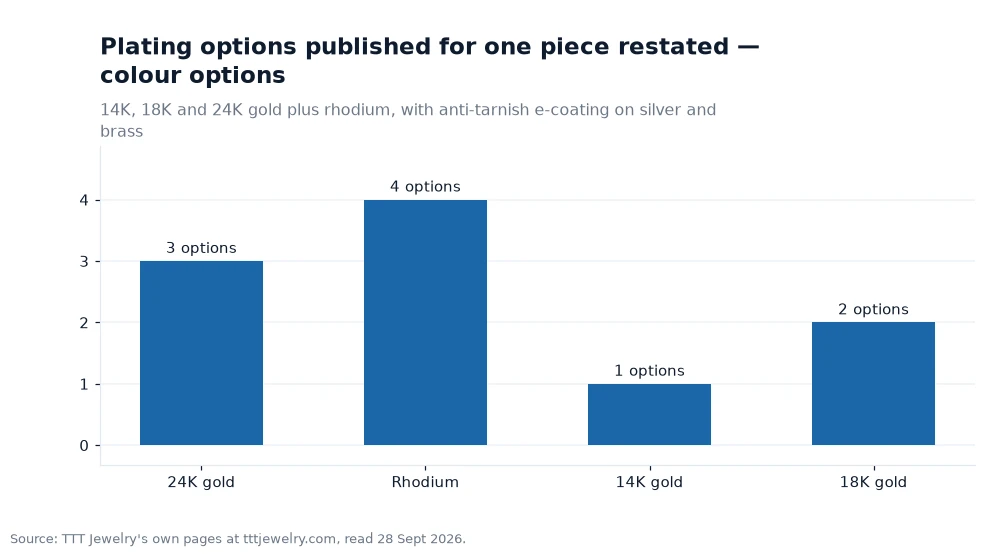
The manufacturer lists multi-layer precious metal plating in 14K gold, 18K gold, 24K gold and rhodium, in that publication order, with silver and brass taking an additional anti-tarnish e-coating and stainless steel going through PVD. Four colour options on one silhouette is normal for a fashion line; four colour options on one order is a different matter, because each finish is a separate plating run in the chamber.
Gold tone is not the same as gold content, and the hallmarks show the split. A steel piece is struck 316L, a silver piece S925, and a gold-plated piece 18KGP. Putting the right mark on the right metal is part of the laser engraving step that also takes a brand's own logo, so the mark and the logo are set in the same operation.
What the sample has to prove before bulk starts
| Stage | Published figure | What it decides for a 316L design |
|---|---|---|
| 3D CAD modelling | Under 48 hours | Wall thickness and clasp geometry before tooling |
| Master physical sampling | 25–35 days | Wax printing, casting, setting, polishing, plating |
| Mass production | 3–4 weeks | Batch size and delivery date |
| MOQ | 100–150 pcs by style | Whether the design goes to steel or to brass |
| Final quality control | 100% inspected | Packing list and shipment release |
The sample is where a steel design is either proven or quietly abandoned. A PVD chamber run on a single piece shows the true colour, the true surface after brushing, and whether the clasp tolerates the plating temperature. Approving from a photograph rather than a physical master sample is the most common way a first order goes wrong.
Worked example: what four finishes do to a first order
Take one steel design at the published band and ask for all four colour options. The finishes are listed as 14K gold, 18K gold, 24K gold and rhodium, so the arithmetic is 4 × 100 = 400 pieces at the bottom of the band, and 4 × 150 = 600 at the top, for the design to exist in every colour. Splitting one order of 100 pieces four ways would put 25 pieces on each finish, below the published band, so every colour needs its own run inside that band.
The same discipline applies to the rest of the chain. Sampling does not divide: 25–35 days covers the one master sample, and a second colour variant is a second plating pass inside that window rather than a second sample block. Planning four colours as 4 × 30 = 120 days of sampling is wrong; planning them as one approved master plus three extra chamber runs is closer to how the shop floor reads the calendar.
What to put in a steel tech pack
A steel brief should state the base metal, the finish, the hallmark and the packaging in one message. Steel is not interchangeable with brass after the fact — the forming route, the tooling and the plating chamber all change — so a request for "the same design in a cheaper metal" is a new development rather than a substitution.
The rest of the brief is ordinary, and a custom stainless steel jewelry OEM will ask for the same four things: the sketch, a reference photo, the measurements that matter for fit, and the quantities you expect in the first run and the second. The design team turns that into CAD within 48 hours for dimensional sign-off, and the sample window of 25–35 days starts from the approved drawing rather than from the enquiry.
Frequently asked questions
Does stainless steel jewelry need plating at all?
Not for corrosion resistance, but usually for colour. A 316L piece can be left in its natural grey finish, or it can take multi-layer PVD vacuum plating when the design calls for a gold or rhodium tone.
Which hallmark is used on stainless steel pieces?
The hallmark struck on stainless steel is 316L, while silver pieces carry S925 and gold-plated pieces carry 18KGP, all applied during the same laser engraving step as a brand logo.
What is the minimum order for a stainless steel design?
100–150 pieces per style, against 100 pieces for artisan eco-brass and 50 pieces per design for 925 sterling silver, with the difference set by how hard each metal is to tool.
Choosing a maker for a steel line
The useful question for a factory is not what it can make, but which stages it owns. Ask which of the eight steps are subcontracted, whether the plating chamber is on site, and whether the final inspection happens before or after plating. A maker that answers all three in one reply is a maker you can schedule against. The same test works across materials: read how the eco-brass line is finished for plated fashion pieces, and how the silver production route handles casting, before you settle on the metal for a first collection.
Where the numbers come from — the waterproof and sweatproof claim plus the stainless PVD option plus the 100–150 pcs stainless steel floor — is tttjewelry.com, dated 28 Sept 2026. The comparisons drawn from those figures are my own rather than the manufacturer's[1].